

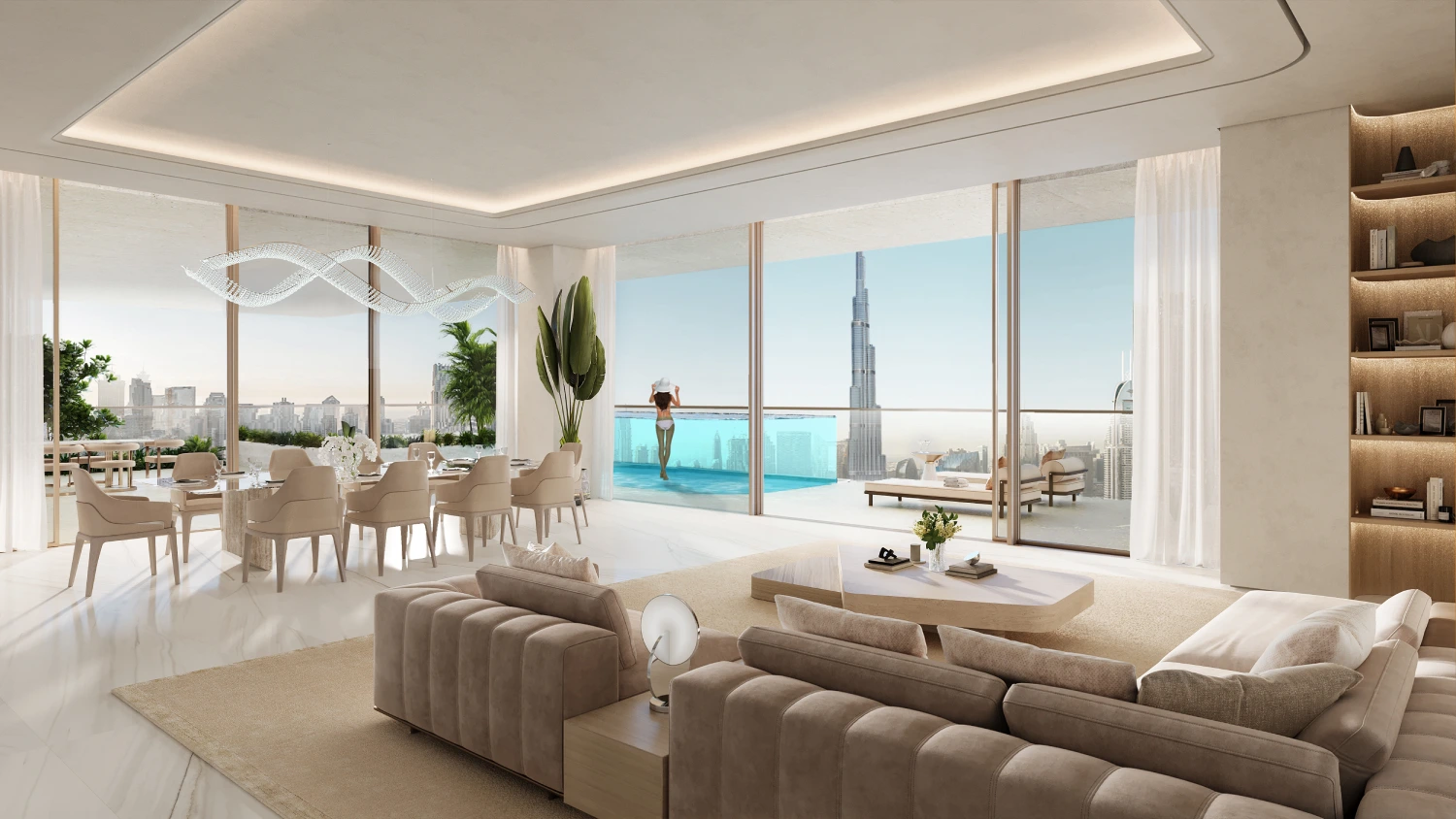
Dubai’s luxury residential market can be both exciting and difficult to navigate. Buyers have access to waterfront residences, branded developments, skyline apartments, private beach communities and highly amenitised towers, often within a relatively short distance of one another.
But an impressive address does not automatically make an apartment a good purchase.
The challenge for buyers is separating genuine long-term value from features that simply look attractive at first glance. A high asking price may reflect scarcity, views and location—or it may simply reflect positioning within a particular development.
For that reason, buying a luxury apartment in Dubai requires a more disciplined approach than comparing listing prices. The strongest decisions come from understanding the property itself, the building, the neighbourhood and the factors that could influence its future desirability.
Dubai’s market continues to show strong demand at the premium end. Bayut’s H1 2026 sales report found that established destinations such as Palm Jumeirah, Bluewaters Island, Dubai Marina and Downtown Dubai remained prominent among luxury and ultra-luxury buyers.
Define What Luxury Means to You
Luxury is subjective.
For one buyer, it may mean a panoramic sea view and private beach access. For another, it could mean a large floor plan, privacy, concierge services or proximity to Dubai’s business districts.
Before comparing properties, establish which characteristics actually matter to you.
An investor might prioritise liquidity and rental demand, while an owner-occupier could place much greater emphasis on the quality of the living environment.
A second-home buyer may value turnkey living and building services, whereas a family may be more interested in space, storage and access to schools and everyday amenities.
This distinction is important because the most expensive apartment available isn’t necessarily the best fit.
Location Still Determines Much of the Value
A premium interior can be renovated. A kitchen can be upgraded. Furniture can be replaced.
Location cannot.
When assessing a luxury apartment, look beyond the neighbourhood’s reputation and consider its position within the wider city.
Ask how easily residents can reach:
-
Major business districts
-
Airports
-
Beaches
-
Shopping destinations
-
Restaurants
-
Schools
-
Healthcare facilities
-
Public transport
-
Major roads
Then consider the property’s position within the community itself.
A tower directly overlooking a waterfront promenade may offer a substantially different experience from another building only a few minutes away.
This is why buyers should evaluate location at both the community level and building level.
Look Beyond the Price Per Square Foot
Price per square foot is useful, but it should never be the sole measure of value.
Two apartments with identical floor areas can command very different prices because of their floor, orientation, view, condition, building and scarcity.
Current market data demonstrates how wide these differences can be. Bayut’s H1 2026 report placed the average price per square foot for ultra-luxury apartments at AED 3,529 in Palm Jumeirah and AED 6,091 in Bluewaters Island, while luxury apartments in Dubai Marina averaged AED 2,111 per square foot.
These are broad market averages rather than valuations for individual properties.
The important takeaway is that buyers should compare properties with genuinely similar characteristics.
A penthouse shouldn’t be benchmarked against a standard one-bedroom apartment simply because they happen to share the same postcode.
Assess the Apartment’s Layout Carefully
Floor area can be misleading.
A 2,000-square-foot apartment with an inefficient layout may feel less spacious than a carefully designed 1,700-square-foot residence.
During a viewing, consider how the space actually works.
Look at the relationship between living and dining areas, bedroom positioning, storage, kitchen configuration and access to outdoor space.
For larger apartments, consider whether there is a logical separation between entertaining and private areas.
This is especially relevant for buyers purchasing luxury residences as long-term homes. A visually impressive floor plan isn’t necessarily a practical one.
Treat the View as an Asset
In Dubai’s premium market, views can account for a substantial portion of a property’s appeal.
A direct sea view, marina outlook, skyline panorama or landmark-facing apartment may command a considerable premium over a unit facing another building.
But buyers should ask three questions:
What is the view today?
What could affect it tomorrow?
How much am I paying for it?
The second question is particularly important.
A view that appears permanently protected may not be if there are undeveloped plots or planned projects nearby. Buyers should investigate the surrounding development pipeline before paying a substantial premium for an outlook.
Consider Privacy and Density
Privacy becomes increasingly important as property prices rise.
A buyer looking at a conventional apartment may be satisfied with standard communal facilities. Someone purchasing a trophy residence may expect a considerably more private experience.
Consider:
-
Number of units in the building
-
Lift arrangements
-
Entrance access
-
Distance from neighbouring properties
-
Terrace visibility
-
Parking arrangements
-
Security
-
Separation between residential and public spaces
A residence that provides privacy without sacrificing convenience can have a stronger luxury proposition than one that simply offers more amenities.
The Building Is Part of the Purchase
One of the easiest mistakes is to evaluate only the apartment.
Luxury property should be assessed as a complete building ecosystem.
Visit the lobby. Examine the lifts. Look at the corridors. Inspect the parking areas. Assess the condition of shared facilities.
Pay attention to whether the building feels well maintained and professionally managed.
A beautifully renovated apartment inside a poorly maintained tower can create significant frustration over time.
Conversely, a well-managed building can preserve the quality of the residential experience long after the initial purchase.
Don’t Be Distracted by an Endless Amenities List
Modern developments often advertise extensive facilities.
Pools, gyms, lounges, cinemas, spas, children’s areas, business centres and concierge services can all contribute to a premium lifestyle.
But quantity isn’t the same as quality.
Ask whether the facilities are:
-
Well maintained
-
Appropriately sized
-
Conveniently accessible
-
Suitable for the residents
-
Included within reasonable ongoing costs
A smaller collection of excellent facilities may be considerably more valuable than a huge amenity package that is expensive to maintain and rarely used.
Understand the Cost of Ownership
The purchase price is only one part of the financial calculation.
Buyers should also consider service charges, maintenance, utilities, insurance, furnishing and financing costs where applicable.
Service charges deserve particular attention in premium developments.
A building with extensive shared facilities may have considerably higher recurring costs than a simpler development.
This doesn’t automatically make it a poor purchase. The question is whether the additional cost provides benefits that matter to you.
For an investor, these expenses should be incorporated into the projected net return rather than evaluating the property using gross rental income alone.
Examine Current Market Evidence
Market reports can help establish context, but they should be used carefully.
For example, Bayut reported that Dubai Marina remained one of the leading areas for luxury apartment purchases during H1 2026, with an average transaction value of approximately AED 2.4 million and a reported ROI of 5.88% for its luxury-apartment category. Downtown Dubai recorded a considerably higher average transaction value of approximately AED 4.09 million.
These figures demonstrate why the term luxury covers a broad spectrum.
A buyer should therefore avoid making decisions based on city-wide averages. The more expensive the property, the more important property-specific evidence becomes.
Understand the Difference Between Luxury and Ultra-Luxury
The distinction becomes particularly important at the top of the market.
Luxury generally describes properties with premium locations, high-quality finishes, strong amenities and desirable lifestyles.
Ultra-luxury tends to involve additional layers of scarcity and exclusivity.
This might include:
-
Very large floor plans
-
Private elevators
-
Exceptional waterfront positions
-
Branded residences
-
Private pools
-
Large terraces
-
Bespoke interiors
-
High levels of service
-
Limited inventory
When evaluating Ultra luxury real estate dubai, buyers should therefore ask what makes the property genuinely scarce rather than simply expensive.
If several hundred comparable units exist, the property may have a different long-term proposition from a residence with a genuinely limited supply.
Compare Like-for-Like Properties
When researching Apartments for sale in Dubai, it is tempting to compare properties based on headline price alone.
A more useful comparison considers at least six variables:
|
Factor |
What to compare |
|
Location |
Community and exact building position |
|
Size |
Internal and external usable space |
|
View |
Quality and potential permanence |
|
Building |
Age, management and condition |
|
Costs |
Service charges and maintenance |
|
Market |
Recent comparable transactions |
This approach can reveal why two seemingly similar apartments have very different asking prices.
It can also prevent buyers from assuming that the cheapest property represents the best opportunity.
Consider Rental Demand Even If You Plan to Live There
A property doesn’t need to be purchased as an investment to benefit from rental appeal.
Circumstances can change. You might relocate, spend more time abroad or decide to keep the property as an investment after moving elsewhere.
Dubai Marina provides an example of an established premium rental market. Bayut’s H1 2026 rental report recorded average asking rents of AED 153,000 for luxury apartments in Dubai Marina, with average transaction rents of AED 135,184.
Again, these are market-level figures rather than expectations for every apartment.
Unit type, furnishing, building, floor, view and condition can all influence rental performance.
Nevertheless, an established tenant market can provide additional flexibility for owners.
Investigate the Future of the Area
A property’s surroundings can change.
New roads, infrastructure, retail developments, hotels and residential projects may improve a community, while construction can temporarily affect accessibility, noise and views.
Before buying, investigate the development pipeline around the building.
This is especially important when purchasing a premium apartment primarily because of its outlook.
A buyer paying a significant premium for an unobstructed view should understand what is being built around the property and whether that view has any meaningful protection.
Don’t Ignore Resale Appeal
Even if you intend to own the apartment indefinitely, resale considerations are worth understanding.
A highly personalised property may be perfect for you but less attractive to future buyers.
Properties with broader appeal often have advantages such as:
-
Efficient layouts
-
Desirable locations
-
Strong views
-
Good natural light
-
Quality building management
-
Reasonable ongoing costs
-
Recognisable community amenities
This doesn’t mean every luxury apartment should be designed for the widest possible market.
It simply means buyers should understand how distinctive features affect the potential pool of future purchasers.
Use a Property Viewing as Due Diligence
A viewing should involve more than admiring the interiors.
Walk through the building and surrounding streets.
Listen for noise.
Check natural light.
Look at the condition of common spaces.
Examine parking.
Assess how long it takes to reach major roads or public transport.
Visit at different times of day if possible.
A property can feel completely different on a quiet weekday afternoon compared with a busy evening or weekend.
Build a Long-Term Ownership Model
The final decision should bring together the property’s lifestyle and financial characteristics.
Ask yourself:
Would I enjoy living here?
Are the ongoing costs reasonable for what I receive?
Is the building likely to remain desirable?
Does the location have enduring appeal?
Would another buyer understand the value of the property if I eventually sell?
If I needed to rent it, would there be a meaningful tenant pool?
If the answers are consistently positive, the property is likely being evaluated on stronger foundations than its appearance or asking price alone.
Final Thoughts
Dubai’s luxury property market provides buyers with exceptional choice, but choice makes disciplined evaluation more important.
A premium apartment should be judged not only by its finishes or address but by the complete ownership proposition: location, layout, views, privacy, building quality, amenities, ongoing costs, market demand and future surroundings.
The strongest purchases are rarely based on a single impressive feature.
Instead, they combine several durable advantages that remain valuable even after the initial excitement of the purchase has faded.
For buyers entering Dubai’s premium residential market, taking the time to compare properties systematically can help distinguish genuine long-term value from an expensive apartment that simply looks impressive on paper.